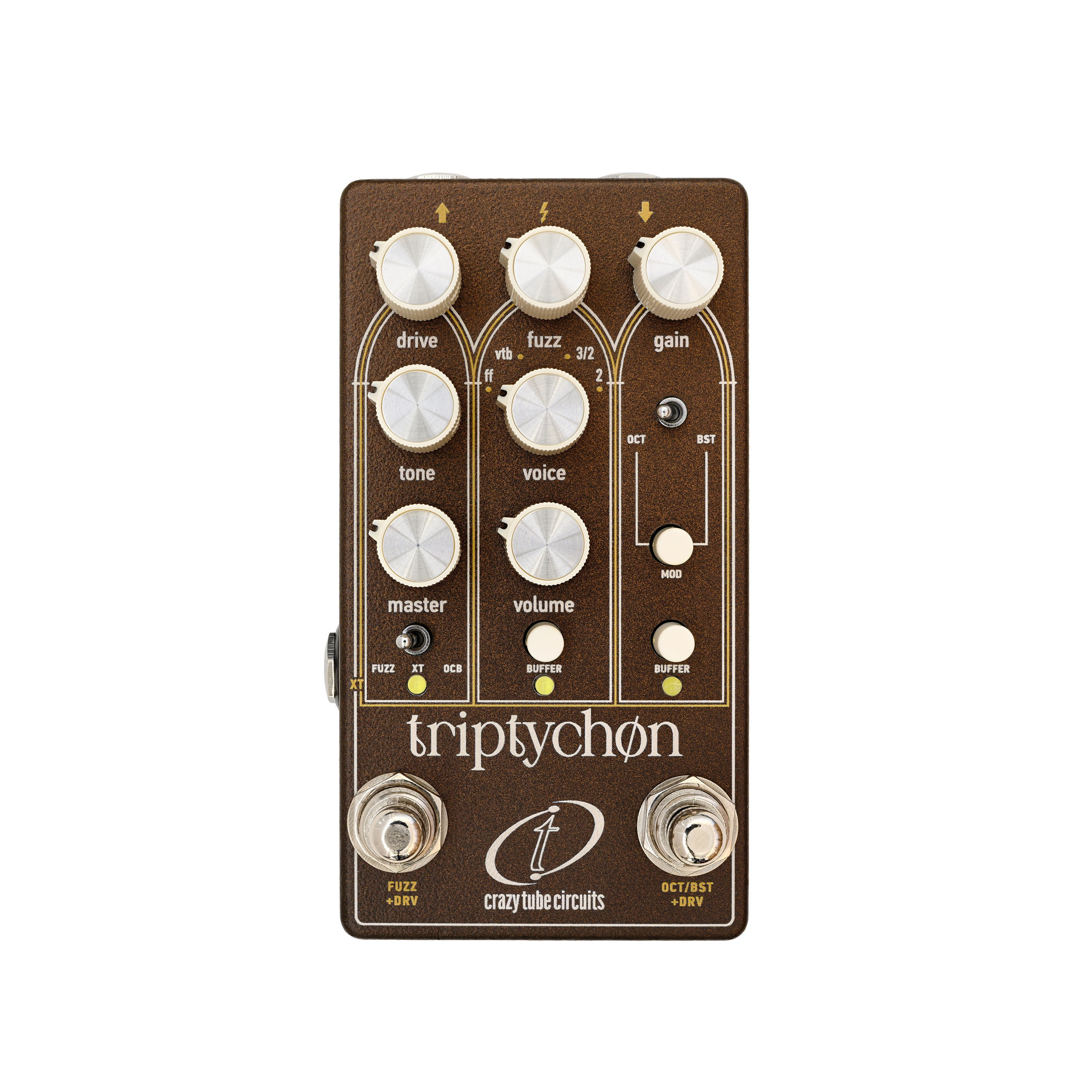
At the core of the Triptychon’s center panel lies a fuzz circuit, delivering four distinct and accurately recreated voices of classic fuzz designs that shaped the sound of electric guitar.
• ff: inspired by Dallas Arbiter Fuzz Face - delivers the classic dynamic response with powerful saturation and excellent cleanup.
• vtb: inspired by Vox Tone Bender - offers a tighter, slightly lower-gain character with more bite and reduced low-end
• 3/2: inspired by Sola Sound Tone Bender Mk1.5 - expands on the ff-style response with added low-frequency weight and a more forceful feel.
• 2: inspired by Sola Sound Tone Bender MkII - provides increased gain, longer sustain, and a more aggressive, harmonically rich voice.
The right panel of Triptychon expands the harmonic range, offering a classic Rangemaster-style treble boost (BST) or an upper octave circuit (OCT). Engaging the MOD switch changes the tonal character:
• MOD off: cleaner, more articulate octave response with improved note separation.
• MOD on: increased gain and a more saturated, fuzz-like octave character with stronger harmonic content, inspired by the classic Foxx Tone Machine.
The left panel completes the Triptychon system by recreating a crucial part of classic signal chains: the behavior of a pushed amplifier, designed to emulate the compression, saturation, and harmonic contribution of an amplifier operating near its limits.
It is designed to support and elevate the behavior of the other stages. This is the environment in which fuzzes and treble boosters historically thrived, and a key element in achieving authentic vintage response.
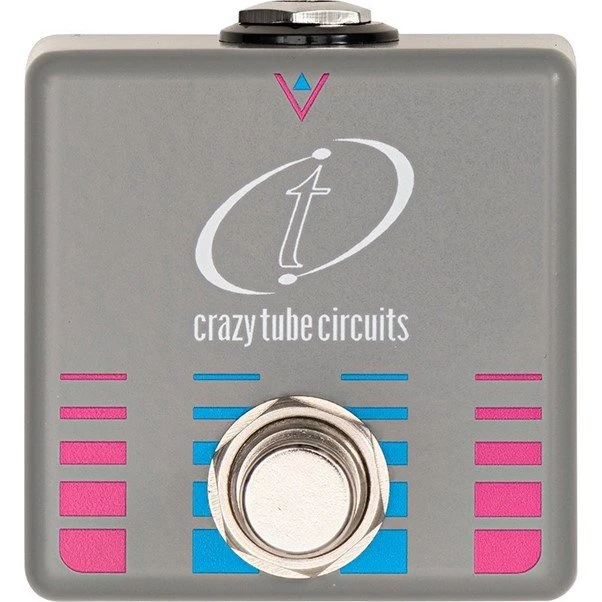
The drive can be used on its own as a musical, dynamic overdrive, or can be assigned to either the fuzz or the boost/octave footswitch. The external XT footswitch (sold separately) enables the drive section to function completely independently.
Classic Germanium-based fuzz circuits are known for their organic tone, but are also highly sensitive to temperature and environmental conditions. Triptychon recreates these characteristics using metal-can silicon transistors achieving the same feel and response while maintaining consistency in any environment.
Classic fuzz and treble booster circuits are designed to interact directly with the high impedance of passive guitar pickups. This interaction is critical for achieving the correct frequency balance and dynamic response.
Triptychon incorporates dedicated (anti)buffer circuits on both the fuzz and boost sections. These circuits actively reshape the input impedance seen by each stage, restoring the electrical conditions of a direct connection to passive pickups. This means that even when buffers or active systems are present, Triptychon preserves the feel, cleanup, and frequency behavior of the classic designs.
For optimal results, the anti-buffer circuits should be engaged only when a buffered pedal or active pickups are present before Triptychon. When the pedal is fed directly from passive guitar pickups, it is recommended to leave them disengaged.
• 3-in-1 fuzz/octafuzz, treble booster and overdrive pedal
• Three independent tone engines forming one unified system - fuzz, treble booster, octave fuzz, and overdrive in a fully integrated, assignable architecture
• Recreates the way classic tones were made - emulates the full signal chain of vintage recordings, where fuzzes and treble boosters were driven into already pushed amplifiers, now adapted for modern clean- platform rigs
• Germanium feel without germanium problems - custom transistor piggybacking design using metal-can silicon transistors for authentic cleanup, response, and consistency
• Matching circuits (anti-buffer) for correct operation after buffers or active pickups
• Inspired by classic pedal designs of the past like Dallas Arbiter Fuzz Face, Vox Tone Bender, Sola Sound Tone Bender Mk1.5 and MkII, Foxx Tone Machine and Dallas Rangemaster
• Controls octave/boost section (right panel): gain of octave or boost, OCT (upper octave fuzz) or BST (treble booster) selection toggle switch, MOD voicing shift push switch, (anti)buffer circuit
• Controls fuzz section (center panel): fuzz intensity, fuzz voice, fuzz volume, (anti)buffer circuit.
• Controls overdrive section (left panel): drive amount, tone balance, master output level, operation assign toggle switch
• Two on-board footswitches: for fuzz (left) and octave/-boost(right). Drive section assignable to onboard footswitch or external control via XT Footswitch (sold separately)
• Each section (panel) is true bypass via high-quality relays
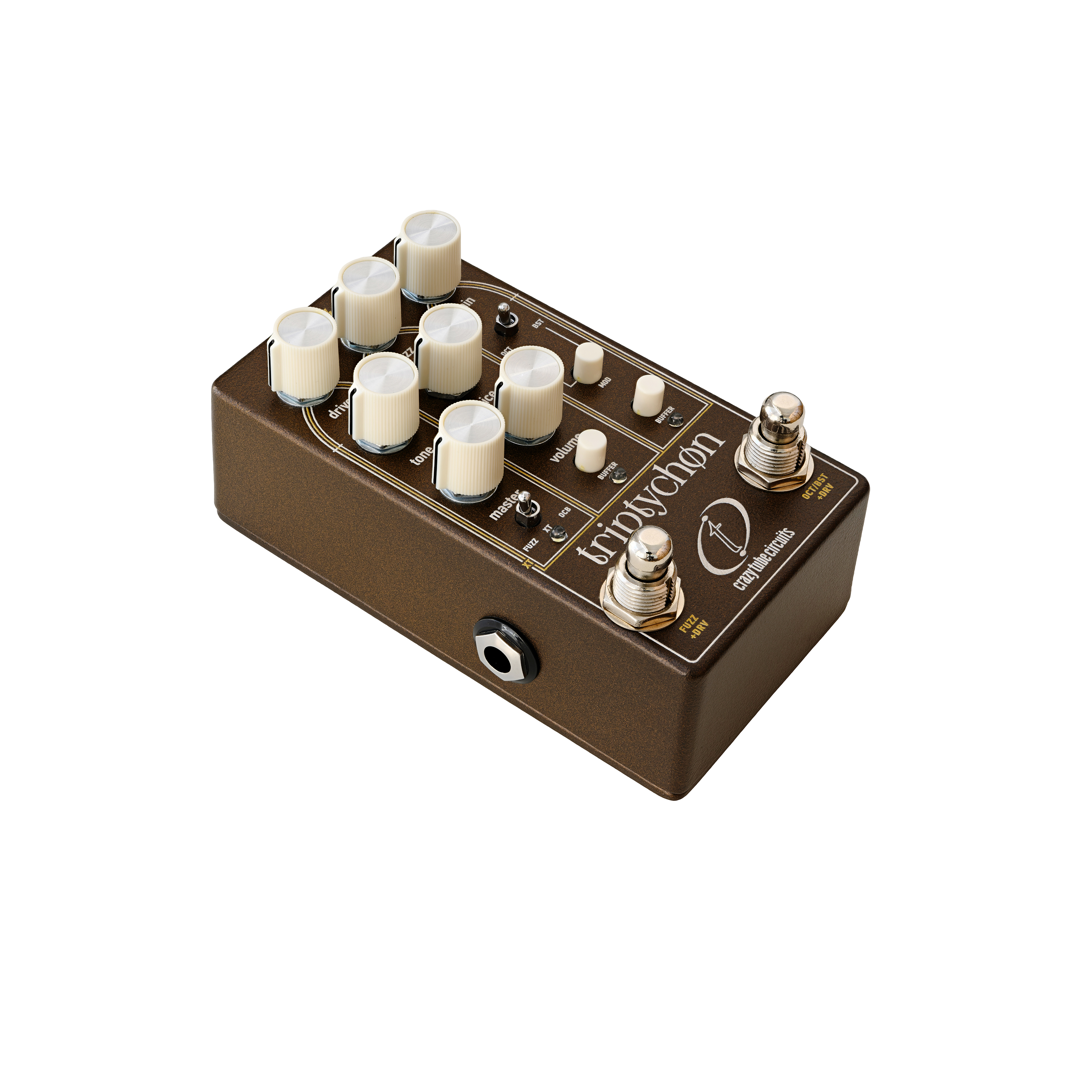
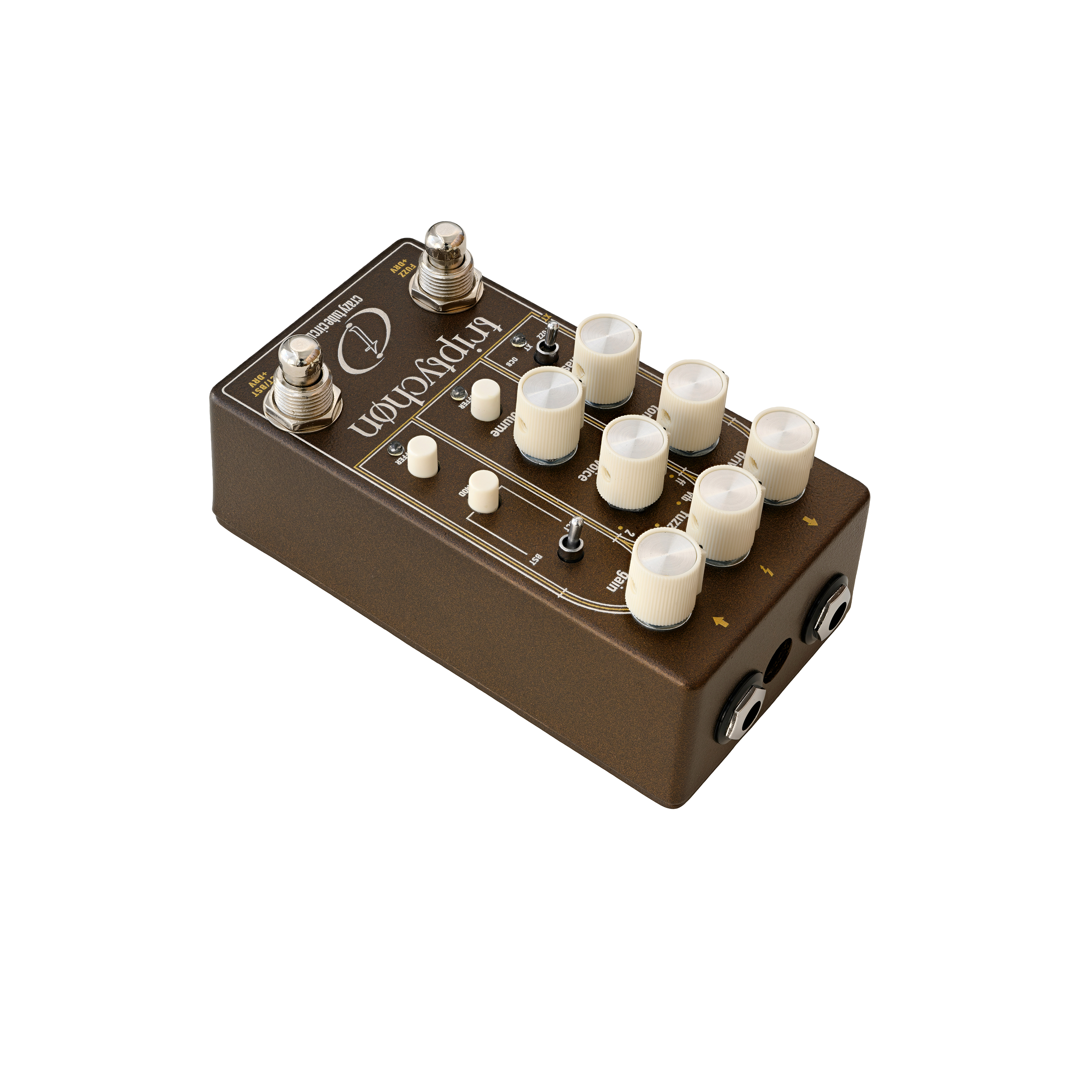
• Top mounted input and output jacks (1/4”)
• XT Footswitch jack on left side (1/4”)
• Power Supply: 9V DC / 80mA, center negative (not included - Isolated power supply recommended)
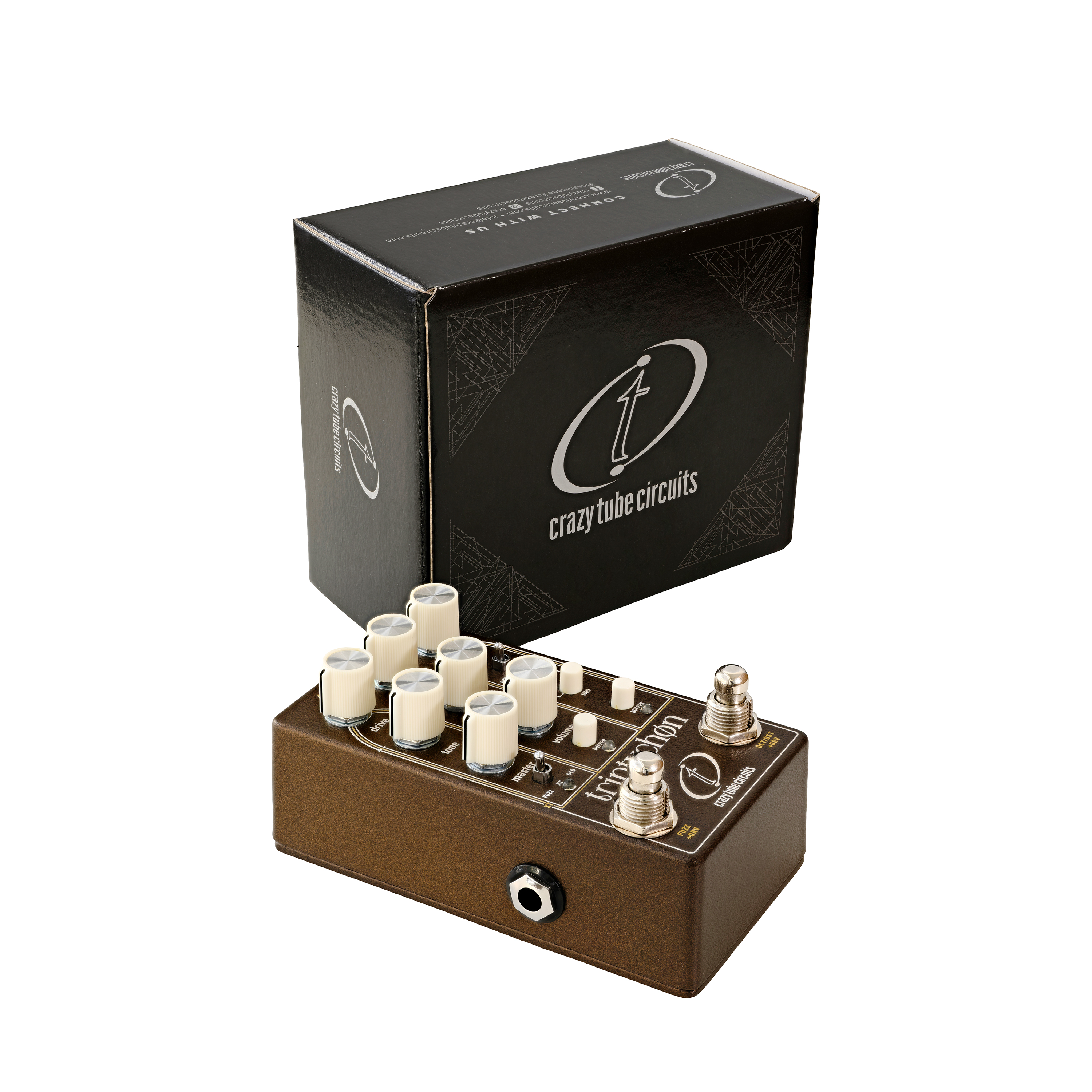
• Bronze-Brown finish die-cast enclosure, inspired by the timeless textures of classic art and sound
• Dimensions: (W x L x H): 69 x 125 x 58 mm
• Weight: 385g
• Designed and hand-built in Athens, Greece.
Disclaimer
Dallas Arbiter, Rangemaster, Fuzz Face, Vox, Tone Bender, Sola Sound and Foxx Tone Machine may be registered trademarks.
Crazy Tube Circuits is not affiliated with or endorsed by any of these companies or respective owners of these trademarks.
Triptychon is built around the concept of the triptych: a three-part structure where each element stands on its own yet gains its full meaning when combined with the others. In this context, the pedal is divided into three distinct but interconnected sections, each representing a fundamental building block of electric guitar tone. Individually complete, yet designed to interact, these three “panels” form a unified sonic system where the relationship between stages is as important as the stages themselves.





%201.png)
%201.png)